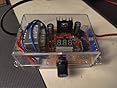
LM317 Adjustable Power Supply DIY Kit, PEMENOL AC-DC 110V to 1.25V-12V Regulated Voltage Module with LED Display, Signal Generator&Power Supply Module, Electronics Soldering Practice Kit for Learning

LM317 Adjustable Power Supply DIY Kit, PEMENOL AC-DC 110V to 1.25V-12V Regulated Voltage Module with LED Display, Signal Generator&Power Supply Module, Electronics Soldering Practice Kit for Learning
Price: $17.99 - $17.09
(as of Jan 25,2026 15:07:19 UTC – Details)

Buy Now


To calculate the overall star rating and percentage breakdown by star, we don’t use a simple average. Instead, our system considers things like how recent a review is and if the reviewer bought the item on Amazon. It also analyzed reviews to verify trustworthiness.Learn more how customers reviews work on Amazon


Customers say

Customers find the power supply kit easy to assemble and appreciate its quality components and design. The functionality receives mixed feedback, with some saying it works surprisingly well while others report issues. The voltage regulation and instruction quality also get mixed reviews, with some finding the instructions clear while others disagree. Customers disagree on the accuracy of the voltage display, with one noting it only shows one significant digit.

AI Generated from the text of customer reviews

Select to learn more

11 customers mention ease of assembly, 11 positive, 0 negative

Customers find the power supply kit easy to assemble, describing it as a blast to build, with one customer noting that the assembly photos and notes are pleasant surprises.

This kit was easy to build and worked perfectly the first time I plugged it in. Highly recommended.Read more

…clearly labeled circuit board, case, and assembly photos and notes are all a pleasant surprise….Read more

Not very difficult at all to put together.Read more

Easy to assemble. Verty well designed case. Func.tions as expectedRead more

7 customers mention design, 7 positive, 0 negative

Customers like the design of the power supply kit.

…So, I think this is a GREAT KIT to use as a teaching example for a beginner being guided by someone more experienced, and a nice low DC variable…Read more

This is a nice kit. The enclosure is a nice addition, and it being clear means you can look at the circuit while you blow it up during learning….Read more

Really cool little kit! Ton of fun to put together. Instructions are a bit lacking so I was going mostly off of the photo included….Read more

Awesome project. Very easy to assemble. The circuit board, itself, basically guides you through assembly….Read more

7 customers mention quality, 6 positive, 1 negative

Customers appreciate the power supply's quality components, with one customer noting it's a perfect power supply and another mentioning they enjoyed building it.

The electronic and physical component quality, clearly labeled circuit board, case, and assembly photos and notes are all a pleasant surprise….Read more

…It provides a variable 1.2 – 14.2 VDC @ 200mA. The circuit board is very well made and the parts placement graphics on the board are very clear and…Read more

…tinker in the garage with electronic circuits, this kit was the perfect power supply for the types of circuits I build without spending a ton of…Read more

I was pretty surprised by the quality of this kit. If you are looking for something to build that is easy then this is it….Read more

5 customers mention beginner level, 4 positive, 1 negative

Customers find the power supply kit suitable for beginners, with one mentioning it's a great way to learn about electronics.

This turned out to be a very worthwhile practice kit. The fact that it has a case and comes complete with all the parts is excellent….Read more

…In my opinion, this kit is a great way to learn about: – Line noise – Input ripple – Output ripple – Dropout voltage -…Read more

Fun and useful little project!…Read more

…That being said, this is not a kit for a beginner. The polarity of parts is not mentioned, the order of operations is not addressed, etc….Read more

19 customers mention functionality, 13 positive, 6 negative

Customers have mixed experiences with the power supply's functionality, with some finding it works surprisingly well, while others report issues with it not working at all.

Everything assembled fine and it works greatRead more

…The finished kit worked perfectly the first time….Read more

i tryed hooking up a fan thats 12v @ 0.35 amps and it just dont spin at all had amazon send me a new one built it and the same thing ill be sending…Read more

…The circuit board, itself, basically guides you through assembly. Works perfectly and allows me to power up other projects similiar to this.Read more

9 customers mention voltage regulation, 5 positive, 4 negative

Customers have mixed experiences with the voltage regulation of the power supply, with some finding it performs well, while others report issues with low output power and slow voltage changes.

…being guided by someone more experienced, and a nice low DC variable voltage supply comes out of it….Read more

…I pinned it out and checked voltage and I'm getting no voltage from the transformer and it gets super hot when plugged in….Read more

…Works perfectly and allows me to power up other projects similiar to this.Read more

…The amount of current that it provides is low, and it is really just for small projects….Read more

7 customers mention instruction quality, 3 positive, 4 negative

Customers have mixed opinions about the instructions for the power supply kit, with some finding them clear while others say they are not great.

…The assembly instruction sheet absolutely sucks but with careful attention to the board graphics the kit can be assembled without faults….Read more

…This was a blast to build. Instructions were clear and included pictures. The board was also clearly marked….Read more

…with a logic circuit and some adjustments however the instructions are a little lacking on how to use these options….Read more

…The manual is pretty good. There are some spelling and grammar errors, but it is understandable. It has a good explanation of how the circuit works….Read more

5 customers mention accuracy, 2 positive, 3 negative

Customers have mixed opinions about the power supply's accuracy, with some reporting accurate voltage readings, while others note issues with the display showing only one significant digit.

…I will say that the display only shows one significant digit, so it is generally going to feel inaccurate – once you test with a multimeter you will…Read more

…made and the parts placement graphics on the board are very clear and accurate….Read more

…There is a logic input circuit, but for me it only detected LOW, not HIGH. I checked the polarity of the LED and it is correct….Read more

…Impressive performance. Works surprisingly well. Accurate voltage readings. My scope was a difference of .1VDC from the LCD display….Read more


Nice kit for beginners

5 out of 5 stars

Nice kit for beginners
This is a nice kit. The enclosure is a nice addition, and it being clear means you can look at the circuit while you blow it up during learning. =) And, BONUS: when you release the magic smoke, it will still be kept inside the container and can be re-harvested!! 🙂  In general, this kit is for experimenting with power supplies. It is relatively safe, and will be easy to hack if desired. It is not intended to provide a lot of power, which means you can easily see how power supplies behave when they deal with circumstances outside of their capabilities. The manual is pretty good. There are some spelling and grammar errors, but it is understandable. It has a good explanation of how the circuit works. I will add my own comments on that below, but it is well written for the price, and for the target user. Note that there is a minor error in the parts list pictogram. It says there are 4x 1N4007 diodes. However, the Part List is correct (there are actually 6, and 6 are included in the kit). It's just a mistake in box 1 of the part photos. The kit came with several extra screws in case you lose any, which is good. In my opinion, this kit is a great way to learn about: – Line noise – Input ripple – Output ripple – Dropout voltage – Load regulation – How to read a datasheet (LM317)   There is a logic input circuit, but for me it only detected LOW, not HIGH. I checked the polarity of the LED and it is correct. Not sure what I did wrong there. It's probably just a mistake I made in assembling it. There is an adjustable interval timer with an output pin that can be used for something. I don't really have a use for it, but it's an interesting feature. The frequency of the "Signal output" terminal can be set using the "signal adjust" potentiometer next to the terminals. The frequency is adjustable between ~320mHz and ~10Hz. SAFETY WARNING: When you build this, DO NOT IGNORE the heat shrink tubing of the mains wires. Be very careful with these since shorting them will pop your circuit breaker and make a beautiful, terrifying spark. 🙂 You can shrink the tubing with a soldering iron by holding the iron very close right underneath the tubing after sliding it over the exposed wire. It will take a minute, but it works just fine. You do not need a heat gun to do it! A hair dryer might even work, but I usually just use the tip of my iron. Don't touch the iron to the tubing, though. It smells really nasty and will mess up your tip. You just want the heat to float off the tip and bake it a little. As stated in the manual, the output power of this circuit is very low. This is intentional. Higher output power could be hazardous to people who are learning. It is important to understand that even though the voltage can be set to 13.6V (the output voltage of the transformer minus the drop of the two diodes for each half of the bridge rectifier), the circuit will not provide power at that level. This is because the regulator has a drop voltage. In order to regulate the output voltage, the input voltage must be 1.2V greater than the desired output voltage. Therefore, the true usable voltage range is equivalent to what is given in the manual pamphlet: 1.25-12V. 1.25V is the minimum voltage the LM317 can provide because that is what it uses as an internal voltage reference. If you attempt to set the voltage above 13.1V or so, you will see significant voltage noise (100mV or above). This is because the regulator is no longer fully regulating its input voltage. Since the input voltage is coming from a mains transformer, the frequency will be 2 times that of the input voltage of that transformer. In the US, that is 60Hz. The bridge rectifier flips the negative half of that voltage positive, resulting in a 120Hz "bunny hop" waveform. If you were to measure the voltage at C4, you would see this waveform. If you set the voltage of the output greater than 13 or so volts, you will see the same shape waveform on the output from the regulator, due to the reasons stated above. It is also important to note that exceeding the output power rating (2.5W is what the manual states) will result in poor regulation as well (ripple and voltage drop). This is declared in the manual. After building the circuit, I measured the voltage ripple under various load conditions: With no load: – @12.2V: less than 5mV ripple – @1.2V: less than 5mV ripple With a load of 100mA, the ripple was: – @12.2V: Voltage reduced to 8.4V, 400mV ripple – @1.2V: less than 6mV ripple With a constant current load of 25mA: – @11.8V: ~100mV ripple – @1.20V: ~5mV ripple The manual says that 200mA of current can be supplied, so I determined the maximum voltage at which 200mA could be supplied with satisfactory ripple (let's say 100mVpp). This turned out to be about 3.75V. This might be improved by experimenting with the circuit and increasing the capacitance of C1 (you can add more in parallel). The power supply output voltage will change more slowly, since there is a lot of stored energy at the previous voltage when it is being lowered. It will also take a while to raise the voltage with more capacitance on the output. There is a tradeoff between smooth voltage level and rapid output regulation. I would start with at least 2500uF of capacitance if you want to try this out. (It comes with 680, so just boost it from there). I noticed that, at 200mA output current at 3.75V, the case got a little bit warm after about 15 minutes. The regulator will release the most heat at LOWER voltages. This is because it has to dissipate power in order to reduce the voltage on the input to the voltage on the output. At higher output voltages, you will be limited by how much power can be delivered. At lower voltages, that same limit exists, but the majority of the power is not delivered to the load, but rather dissipated as heat. Again, the kit is good for experimenting and learning how regulator circuits work. This power supply design has a lot of similarities with power supplies that I have designed in the real world. Usually, I would use better regulator chips (LM317 is not a precision or low dropout regulator). Some fun modifications that could be done to this kit to make it cooler: 1. Cut a hole in the case and install a switch for the mains HOT wire. This would allow the kit to remain plugged in and remove mains current from the input of the transformer. 2. Cut a square hole in the top and move the LED display to the top and add a fogged window. The LED display is very bright (maybe a bit too bright). 3. Replace RP1 with a 10-turn potentiometer. This will give much more precise voltage adjustment. 4. Add a current meter to the output of the regulator. 5. Add a ripple limit detector to the output of the regulator (series capacitor, rectifier, low pass filter, and comparator). 6. Add a thermometer to the transformer and/or regulator heat sink.

Thank you for your feedback

Sorry, there was an error

Sorry we couldn't load the review


Top reviews from the United States


  • Reviewed in the United States on July 13, 2021

    This is a nice kit. The enclosure is a nice addition, and it being clear means you can look at the circuit while you blow it up during learning. =) And, BONUS: when you release the magic smoke, it will still be kept inside the container and can be re-harvested!! 🙂 

    In general, this kit is for experimenting with power supplies. It is relatively safe, and will be easy to hack if desired. It is not intended to provide a lot of power, which means you can easily see how power supplies behave when they deal with circumstances outside of their capabilities.

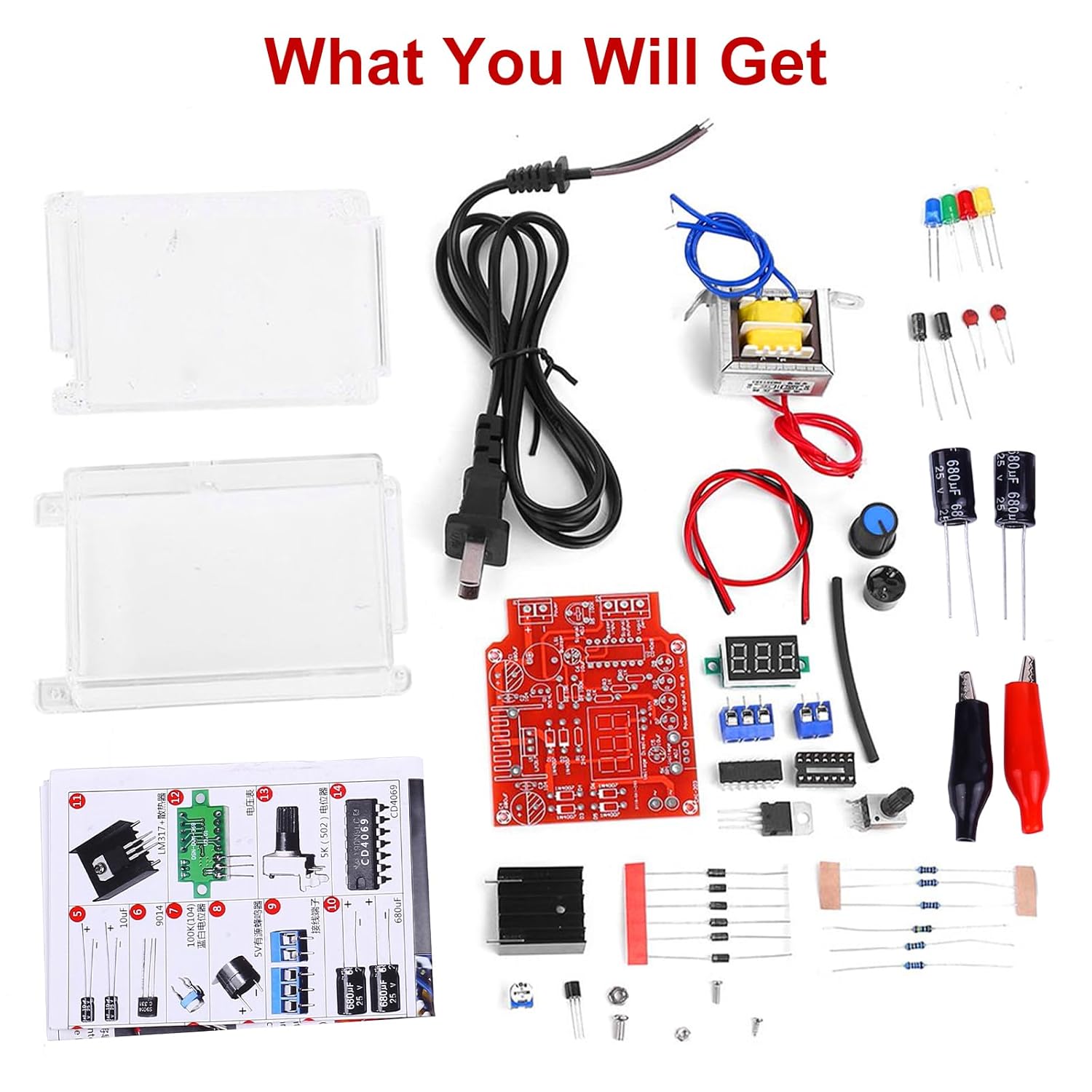
    The manual is pretty good. There are some spelling and grammar errors, but it is understandable. It has a good explanation of how the circuit works. I will add my own comments on that below, but it is well written for the price, and for the target user. Note that there is a minor error in the parts list pictogram. It says there are 4x 1N4007 diodes. However, the Part List is correct (there are actually 6, and 6 are included in the kit). It's just a mistake in box 1 of the part photos.

    The kit came with several extra screws in case you lose any, which is good.

    In my opinion, this kit is a great way to learn about:
    – Line noise
    – Input ripple
    – Output ripple
    – Dropout voltage
    – Load regulation
    – How to read a datasheet (LM317)
     
    There is a logic input circuit, but for me it only detected LOW, not HIGH. I checked the polarity of the LED and it is correct. Not sure what I did wrong there. It's probably just a mistake I made in assembling it.

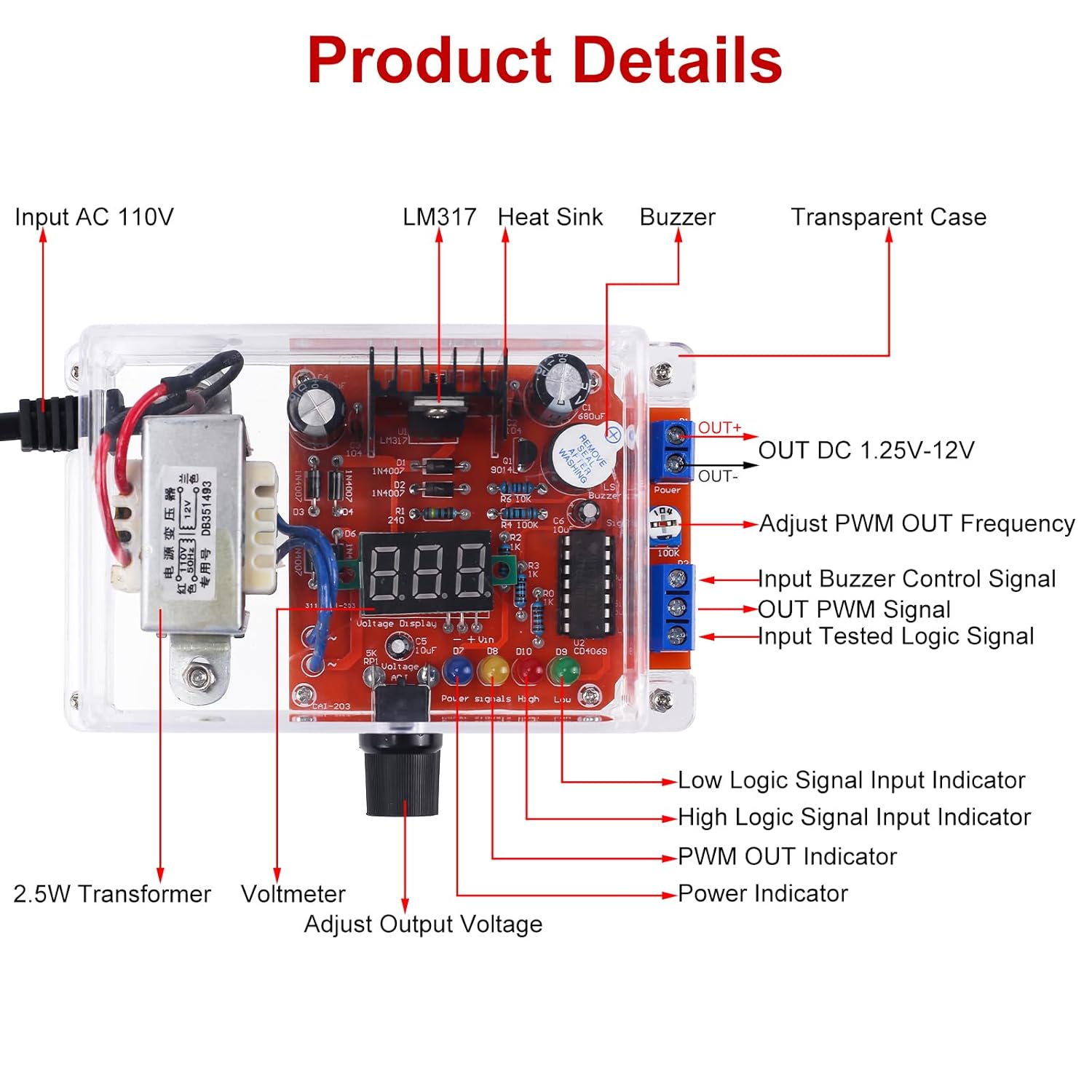
    There is an adjustable interval timer with an output pin that can be used for something. I don't really have a use for it, but it's an interesting feature. The frequency of the "Signal output" terminal can be set using the "signal adjust" potentiometer next to the terminals. The frequency is adjustable between ~320mHz and ~10Hz.

    SAFETY WARNING: When you build this, DO NOT IGNORE the heat shrink tubing of the mains wires. Be very careful with these since shorting them will pop your circuit breaker and make a beautiful, terrifying spark. 🙂 You can shrink the tubing with a soldering iron by holding the iron very close right underneath the tubing after sliding it over the exposed wire. It will take a minute, but it works just fine. You do not need a heat gun to do it! A hair dryer might even work, but I usually just use the tip of my iron. Don't touch the iron to the tubing, though. It smells really nasty and will mess up your tip. You just want the heat to float off the tip and bake it a little.

    As stated in the manual, the output power of this circuit is very low. This is intentional. Higher output power could be hazardous to people who are learning.
    It is important to understand that even though the voltage can be set to 13.6V (the output voltage of the transformer minus the drop of the two diodes for each half of the bridge rectifier), the circuit will not provide power at that level. This is because the regulator has a drop voltage. In order to regulate the output voltage, the input voltage must be 1.2V greater than the desired output voltage. Therefore, the true usable voltage range is equivalent to what is given in the manual pamphlet: 1.25-12V. 1.25V is the minimum voltage the LM317 can provide because that is what it uses as an internal voltage reference.
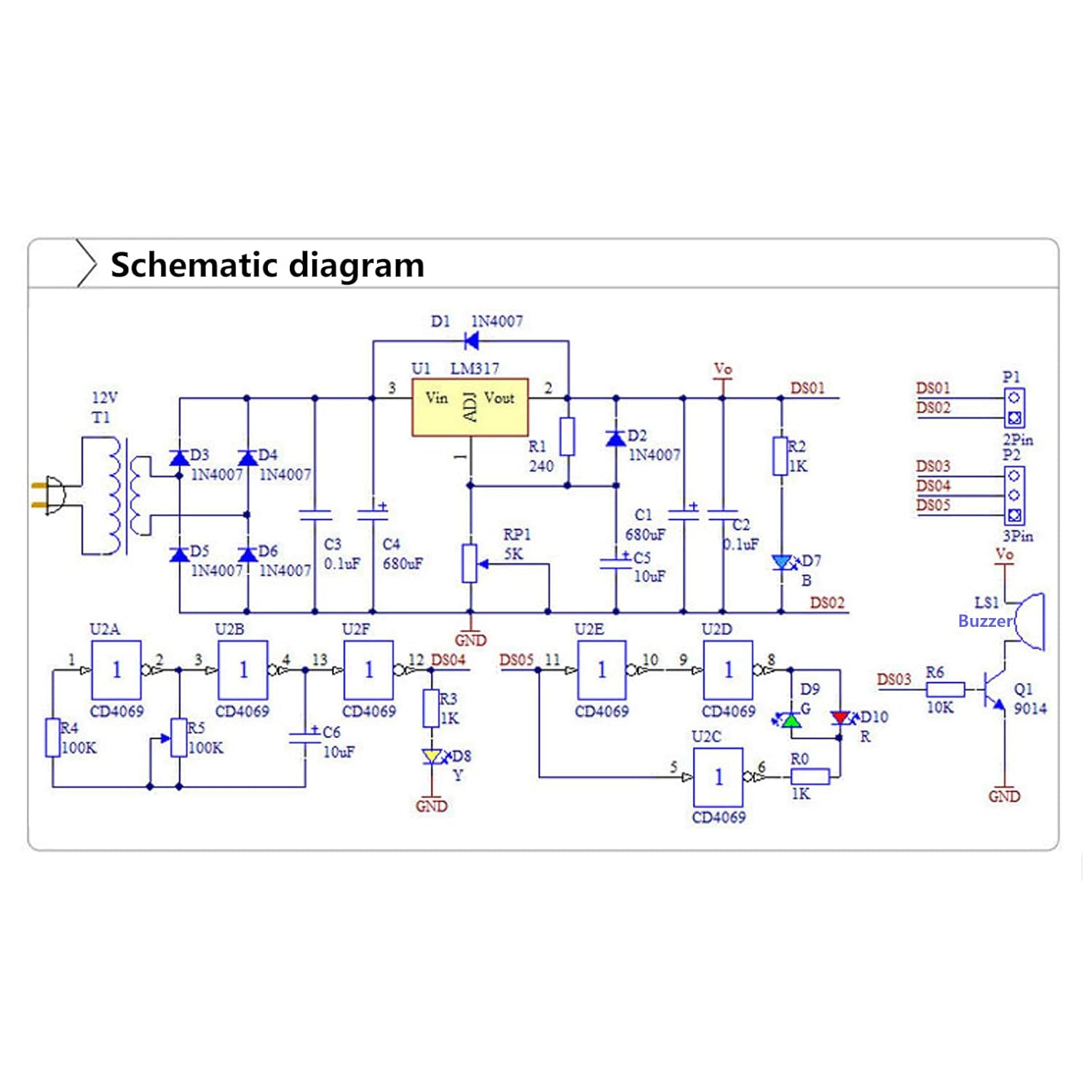
    If you attempt to set the voltage above 13.1V or so, you will see significant voltage noise (100mV or above). This is because the regulator is no longer fully regulating its input voltage. Since the input voltage is coming from a mains transformer, the frequency will be 2 times that of the input voltage of that transformer. In the US, that is 60Hz. The bridge rectifier flips the negative half of that voltage positive, resulting in a 120Hz "bunny hop" waveform. If you were to measure the voltage at C4, you would see this waveform. If you set the voltage of the output greater than 13 or so volts, you will see the same shape waveform on the output from the regulator, due to the reasons stated above.

    It is also important to note that exceeding the output power rating (2.5W is what the manual states) will result in poor regulation as well (ripple and voltage drop). This is declared in the manual.

    After building the circuit, I measured the voltage ripple under various load conditions:
    With no load:
    – @12.2V: less than 5mV ripple
    – @1.2V: less than 5mV ripple
    With a load of 100mA, the ripple was:
    – @12.2V: Voltage reduced to 8.4V, 400mV ripple
    – @1.2V: less than 6mV ripple
    With a constant current load of 25mA:
    – @11.8V: ~100mV ripple
    – @1.20V: ~5mV ripple

    The manual says that 200mA of current can be supplied, so I determined the maximum voltage at which 200mA could be supplied with satisfactory ripple (let's say 100mVpp). This turned out to be about 3.75V. This might be improved by experimenting with the circuit and increasing the capacitance of C1 (you can add more in parallel). The power supply output voltage will change more slowly, since there is a lot of stored energy at the previous voltage when it is being lowered. It will also take a while to raise the voltage with more capacitance on the output. There is a tradeoff between smooth voltage level and rapid output regulation. I would start with at least 2500uF of capacitance if you want to try this out. (It comes with 680, so just boost it from there).

    I noticed that, at 200mA output current at 3.75V, the case got a little bit warm after about 15 minutes. The regulator will release the most heat at LOWER voltages. This is because it has to dissipate power in order to reduce the voltage on the input to the voltage on the output. At higher output voltages, you will be limited by how much power can be delivered. At lower voltages, that same limit exists, but the majority of the power is not delivered to the load, but rather dissipated as heat.
    Again, the kit is good for experimenting and learning how regulator circuits work. This power supply design has a lot of similarities with power supplies that I have designed in the real world. Usually, I would use better regulator chips (LM317 is not a precision or low dropout regulator).

    Some fun modifications that could be done to this kit to make it cooler:
    1. Cut a hole in the case and install a switch for the mains HOT wire. This would allow the kit to remain plugged in and remove mains current from the input of the transformer.
    2. Cut a square hole in the top and move the LED display to the top and add a fogged window. The LED display is very bright (maybe a bit too bright).
    3. Replace RP1 with a 10-turn potentiometer. This will give much more precise voltage adjustment.
    4. Add a current meter to the output of the regulator.
    5. Add a ripple limit detector to the output of the regulator (series capacitor, rectifier, low pass filter, and comparator).
    6. Add a thermometer to the transformer and/or regulator heat sink.

    Customer image


    5.0 out of 5 stars

    Nice kit for beginners

    Reviewed in the United States on July 13, 2021


    This is a nice kit. The enclosure is a nice addition, and it being clear means you can look at the circuit while you blow it up during learning. =) And, BONUS: when you release the magic smoke, it will still be kept inside the container and can be re-harvested!! 🙂 

    In general, this kit is for experimenting with power supplies. It is relatively safe, and will be easy to hack if desired. It is not intended to provide a lot of power, which means you can easily see how power supplies behave when they deal with circumstances outside of their capabilities.

    The manual is pretty good. There are some spelling and grammar errors, but it is understandable. It has a good explanation of how the circuit works. I will add my own comments on that below, but it is well written for the price, and for the target user. Note that there is a minor error in the parts list pictogram. It says there are 4x 1N4007 diodes. However, the Part List is correct (there are actually 6, and 6 are included in the kit). It's just a mistake in box 1 of the part photos.

    The kit came with several extra screws in case you lose any, which is good.

    In my opinion, this kit is a great way to learn about:
    – Line noise
    – Input ripple
    – Output ripple
    – Dropout voltage
    – Load regulation
    – How to read a datasheet (LM317)
     
    There is a logic input circuit, but for me it only detected LOW, not HIGH. I checked the polarity of the LED and it is correct. Not sure what I did wrong there. It's probably just a mistake I made in assembling it.

    There is an adjustable interval timer with an output pin that can be used for something. I don't really have a use for it, but it's an interesting feature. The frequency of the "Signal output" terminal can be set using the "signal adjust" potentiometer next to the terminals. The frequency is adjustable between ~320mHz and ~10Hz.

    SAFETY WARNING: When you build this, DO NOT IGNORE the heat shrink tubing of the mains wires. Be very careful with these since shorting them will pop your circuit breaker and make a beautiful, terrifying spark. 🙂 You can shrink the tubing with a soldering iron by holding the iron very close right underneath the tubing after sliding it over the exposed wire. It will take a minute, but it works just fine. You do not need a heat gun to do it! A hair dryer might even work, but I usually just use the tip of my iron. Don't touch the iron to the tubing, though. It smells really nasty and will mess up your tip. You just want the heat to float off the tip and bake it a little.

    As stated in the manual, the output power of this circuit is very low. This is intentional. Higher output power could be hazardous to people who are learning.
    It is important to understand that even though the voltage can be set to 13.6V (the output voltage of the transformer minus the drop of the two diodes for each half of the bridge rectifier), the circuit will not provide power at that level. This is because the regulator has a drop voltage. In order to regulate the output voltage, the input voltage must be 1.2V greater than the desired output voltage. Therefore, the true usable voltage range is equivalent to what is given in the manual pamphlet: 1.25-12V. 1.25V is the minimum voltage the LM317 can provide because that is what it uses as an internal voltage reference.
    If you attempt to set the voltage above 13.1V or so, you will see significant voltage noise (100mV or above). This is because the regulator is no longer fully regulating its input voltage. Since the input voltage is coming from a mains transformer, the frequency will be 2 times that of the input voltage of that transformer. In the US, that is 60Hz. The bridge rectifier flips the negative half of that voltage positive, resulting in a 120Hz "bunny hop" waveform. If you were to measure the voltage at C4, you would see this waveform. If you set the voltage of the output greater than 13 or so volts, you will see the same shape waveform on the output from the regulator, due to the reasons stated above.

    It is also important to note that exceeding the output power rating (2.5W is what the manual states) will result in poor regulation as well (ripple and voltage drop). This is declared in the manual.

    After building the circuit, I measured the voltage ripple under various load conditions:
    With no load:
    – @12.2V: less than 5mV ripple
    – @1.2V: less than 5mV ripple
    With a load of 100mA, the ripple was:
    – @12.2V: Voltage reduced to 8.4V, 400mV ripple
    – @1.2V: less than 6mV ripple
    With a constant current load of 25mA:
    – @11.8V: ~100mV ripple
    – @1.20V: ~5mV ripple

    The manual says that 200mA of current can be supplied, so I determined the maximum voltage at which 200mA could be supplied with satisfactory ripple (let's say 100mVpp). This turned out to be about 3.75V. This might be improved by experimenting with the circuit and increasing the capacitance of C1 (you can add more in parallel). The power supply output voltage will change more slowly, since there is a lot of stored energy at the previous voltage when it is being lowered. It will also take a while to raise the voltage with more capacitance on the output. There is a tradeoff between smooth voltage level and rapid output regulation. I would start with at least 2500uF of capacitance if you want to try this out. (It comes with 680, so just boost it from there).

    I noticed that, at 200mA output current at 3.75V, the case got a little bit warm after about 15 minutes. The regulator will release the most heat at LOWER voltages. This is because it has to dissipate power in order to reduce the voltage on the input to the voltage on the output. At higher output voltages, you will be limited by how much power can be delivered. At lower voltages, that same limit exists, but the majority of the power is not delivered to the load, but rather dissipated as heat.
    Again, the kit is good for experimenting and learning how regulator circuits work. This power supply design has a lot of similarities with power supplies that I have designed in the real world. Usually, I would use better regulator chips (LM317 is not a precision or low dropout regulator).

    Some fun modifications that could be done to this kit to make it cooler:
    1. Cut a hole in the case and install a switch for the mains HOT wire. This would allow the kit to remain plugged in and remove mains current from the input of the transformer.
    2. Cut a square hole in the top and move the LED display to the top and add a fogged window. The LED display is very bright (maybe a bit too bright).
    3. Replace RP1 with a 10-turn potentiometer. This will give much more precise voltage adjustment.
    4. Add a current meter to the output of the regulator.
    5. Add a ripple limit detector to the output of the regulator (series capacitor, rectifier, low pass filter, and comparator).
    6. Add a thermometer to the transformer and/or regulator heat sink.

    Images in this review


    Customer image


    Customer image


    Customer image


    Customer image


    Customer image


    Customer image


    Customer image


    Customer image


    Customer image


    Customer image


    Customer image


    Customer image

    18 people found this helpful


    Report

  • Reviewed in the United States on March 20, 2024

    The electronic and physical component quality, clearly labeled circuit board, case, and assembly photos and notes are all a pleasant surprise. The instructions even include a nice description of solder joint quality for beginners. There were no missing parts from the included BOM. These great features all combined to make the kit assembly quick and easy. The finished kit worked perfectly the first time. Voltages displayed on the output meter between 1.25V and 14V matched what my expensive multimeter measured within 0.01V (no load), and were repeatable. That being said, this is not a kit for a beginner. The polarity of parts is not mentioned, the order of operations is not addressed, etc. Those have to come from experience and prior knowledge of based through-hole component characteristics. So, I think this is a GREAT KIT to use as a teaching example for a beginner being guided by someone more experienced, and a nice low DC variable voltage supply comes out of it.

    I have only two suggestions for the manufactures of this kit: Including two washers for the small bolts and washers that hold the transformer down would be nice, along with a tiny amount of thermal paste for the LM317/heat sink junction.

    Overall, I highly recommend this kit for anyone with a basic interest in DIY electronics.

    One person found this helpful


    Report

  • Reviewed in the United States on September 12, 2021

    I like it overall and it came packaged pretty nicely. Only issue I had was placing the IC on it and the instructions were very vague. So as a beginner electronics hobbyist, I flipped it and the regulator did not work at first. Once I placed it correctly, it worked great for checking backlights on the tv I was working on. I was able to figure out that one light was burnt out.

  • Reviewed in the United States on January 30, 2023

    I bought this to provide different voltages to different breadboard projects that I'm working on. It took about 1-1/2 hours to assemble and everything fit very well in the provided box. It provides a variable 1.2 – 14.2 VDC @ 200mA. The circuit board is very well made and the parts placement graphics on the board are very clear and accurate. The assembly instruction sheet absolutely sucks but with careful attention to the board graphics the kit can be assembled without faults. For the price, this is a little gem.

    One person found this helpful


    Report

  • Reviewed in the United States on November 24, 2025

    Was fun soldering again, I'm no beginner, but did not work. Leg was bent on transformer, came back and read where someone else had same problem. So took transformer out, tested bad. If it did work would be awesome, worth the money for a kit.

  • Reviewed in the United States on March 26, 2023

    I was pretty surprised by the quality of this kit. If you are looking for something to build that is easy then this is it. You don't even need instructions if you know how to solder. It came with enough pictures to easily show where things go and the printed circuit board is very well printed and well made. Unlike a lot of the kits that come from China you will have no issues assembling this. The case is made for this project and everything fit perfect.

    The only bad side to this (remember the price) is that it does not have a lot of amps. It says in the instructions that it is not even powerful enough to charge your phone. I am still trying that on. It also comes with a logic circuit and some adjustments however the instructions are a little lacking on how to use these options.

    I think I assembled it in just under 2 hours and it was a fun Sunday project. It worked perfect right from the get go. I will probably use it to power an Arduino project.

    For the price I have really no issues.

    One person found this helpful


    Report

  • Reviewed in the United States on September 30, 2024

    I am just getting started with electronics and I needed a power supply to tinker with. This works really well and it's great for testing the function of motors and basic circuits. Totally worth it, I'll probably buy another.

    I will say that the display only shows one significant digit, so it is generally going to feel inaccurate – once you test with a multimeter you will find that it is in fact inaccurate. But it's trivial.


Product Summary: LM317 Adjustable Power Supply DIY Kit, PEMENOL AC-DC 110V to 1.25V-12V Regulated Voltage Module with LED Display, Signal Generator&Power Supply Module, Electronics Soldering Practice Kit for Learning

From PEMENOL
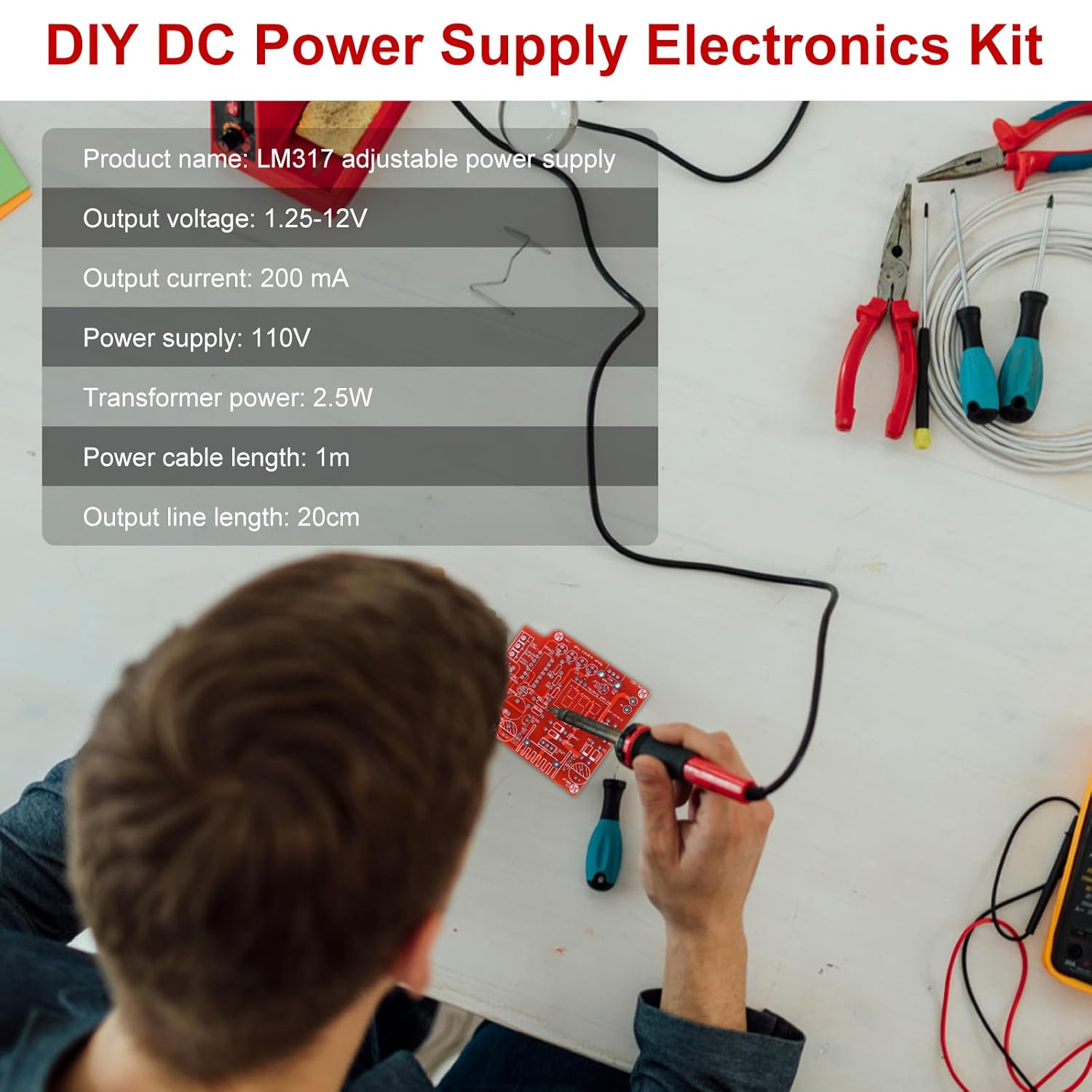
★Adjustable Regulated Power Supply: It is an AC-DC 110V to 1.25V-12V LM317 Adjustable Step Down Power Supply Buck Voltage Converter LED Display DIY Kit. The module can output stable voltage. You can change output by operating a potentiometer
★Multifunctional Welding Training Kit: This kit is suitable for teaching and training as well as for beginners to practice. It is a good choice for electronic enthusiasts. Very good for training your kid’s and student’s Hands-on ability and learning ability. Please read the user manual for the welding method
★RC Signal Generator: 1 channel adjustable signal generator output, convenient to provide pulse signals to the experimental circuit. Because the output current is not large, it is only suitable for powering small current circuits. If the power supply load is too large, the voltage will drop. Can’t charge the phone
★Logic Signal Test Circuit: The adjustable regulated voltage power supply electronics kit has a logic pen function, which is convenient for testing the logic level of the circuit. With 1 channel buzzer. Can test the continuity of the wire, and can also test low-frequency signals
★Application: It can be used as a low-power power supply, signal generator, and logic signal tester. There is a buzzer function for sensor alarms, such as soil moisture alarm, temperature alarm, etc.

Buy Now