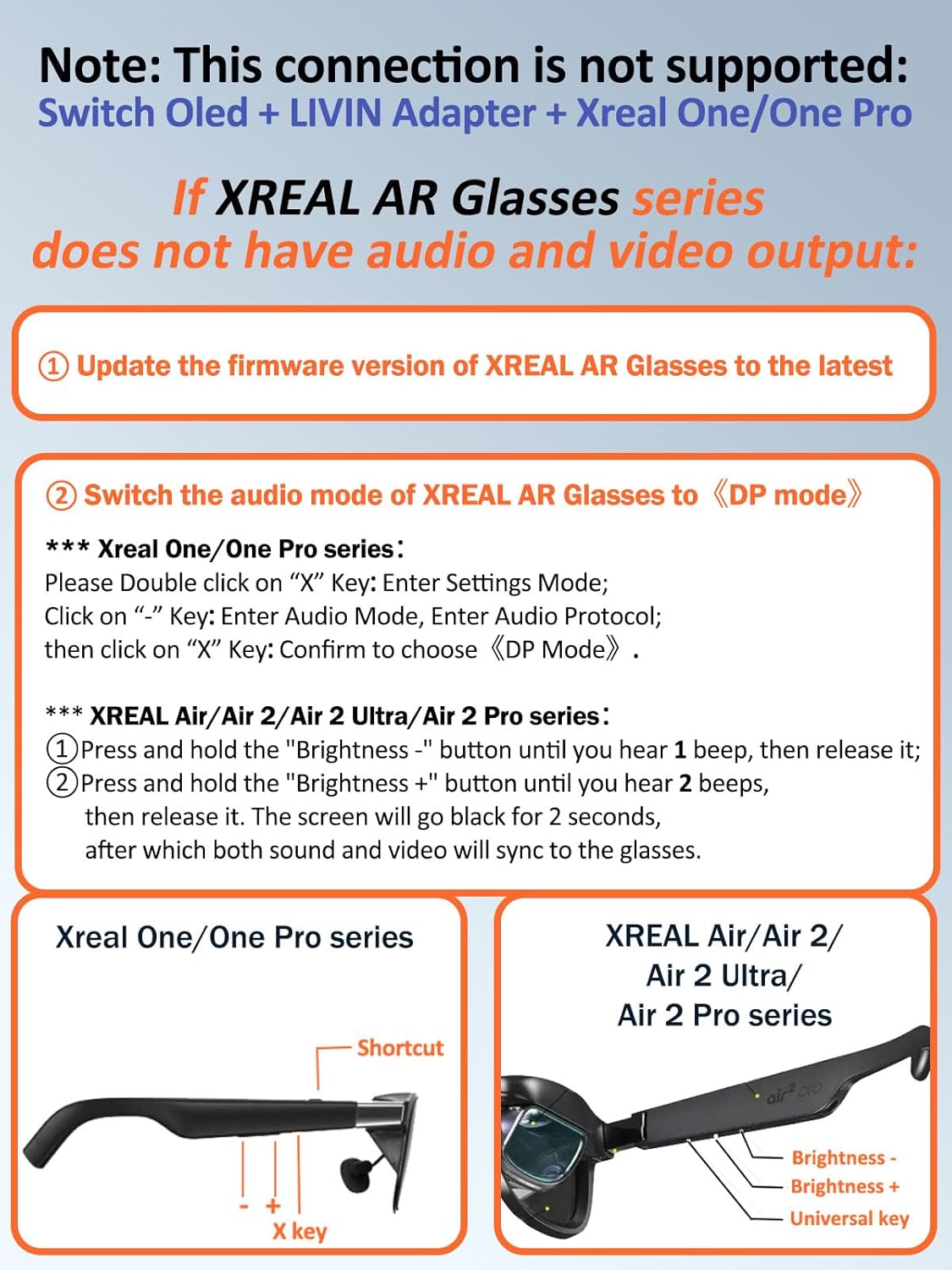
This product works as advertised for its intended use, in my case connecting USB-C sources such as my iPad Pro and Switch to my Viture One AR glasses.
In a perfect world, given that AR glasses accept a USB-C input, and the said devices are known to output video over USB-C, one can imagine plugging the AR glass's source USB-C end directly into one of these devices and merrily going on your way, blissfully entranced in a giant projected screen and never needing to make eye contact with another human being again. My dear reader, this is not our world; (evident by you here, reading this review and evaluating the merits of the LIVIN AR Glasses Adapter.)
As a metaphor, you and your device are the protagonist Danny Roman from the 1998 film The Negotiator, who becomes embroiled in a tense and escalating imbroglio in the first act. What he and you need is Chris Sabian, the eponymous Negotiator, as a neutral party who can be trusted to act impartially at your direction to unravel a much deeper mystery.
If you have ever tried to plug a Switch directly into a USB-C display, you likely know the disappointment that it is often not that simple. (I did have a travel monitor that needed no help, an exception to the rule if there ever was one. Sadly, the backlight was uneven and contrast dreadful.) The reason why it is not simple is that upon connection, the Switch (Danny Roman) must to be assured of two things before he will acquiesce: 1) that there is ample power available (preferred 39W from the OEM AC adapter, or about 45W from elsewhere), and 2) has DP Alt support (don't ask).
The LIVIN AR adapter will accede to both of these stipulations, as it can readily make the DP Alt request and pass through power you have supplied through a side port. (Style points for using a right-angle plug.) Now you are playing with power and can put your glasses on. (Hoobastank?) The end.
Afterword
I've since found that the LIVIN adapter has more versatility than just AR glasses, and has worked for most scenarios I can devise where the power provided to the adapter's side port needs to be bi-directional — it needs to charge the source device (Switch, iPad) and can power the output device (portable monitor) along with the video signal, cleanly over a USB-C 3.1 10gbps cable. Bravo.
Another one is where you are using a USB-C to HDMI cable to send video from a laptop or iPad to a TV. Now you can do this while also charging. Additionally, since the LIVIN adapter talks DP Alt, a Switch is now a viable input. Splendid.
The last odd use involves a unidirectional HDMI + power to USB-C output. A cable I already owned allows an HDMI input device (Blu Ray, Analogue Super NT) to combine with 5V USB-A and output USB-C and a usually unhelpful amount of power. Since the LIVIN adapter source input end is also male, you must additionally supply a USB-C F-to-F coupler (USB 3.1 or better) to create a connection without the tips touching. DisplayPort indeed.








Report