Update from original review: I drove this device with three of the four outputs delivering power to a wire wound resistor bank. I used a fully charged 10S LiPo at 42.2 volts outputting 1.08 Amps total for a total input power of over 45.5 watts. I did run a small 1.25" X 1.25" fan across the board splitting the flow between top and bottom. Ran for several minutes that way and the LM2596 running at 2 amps heated to the point of not being touchable. I'd say this is a pretty solid stress test and the board passed it.
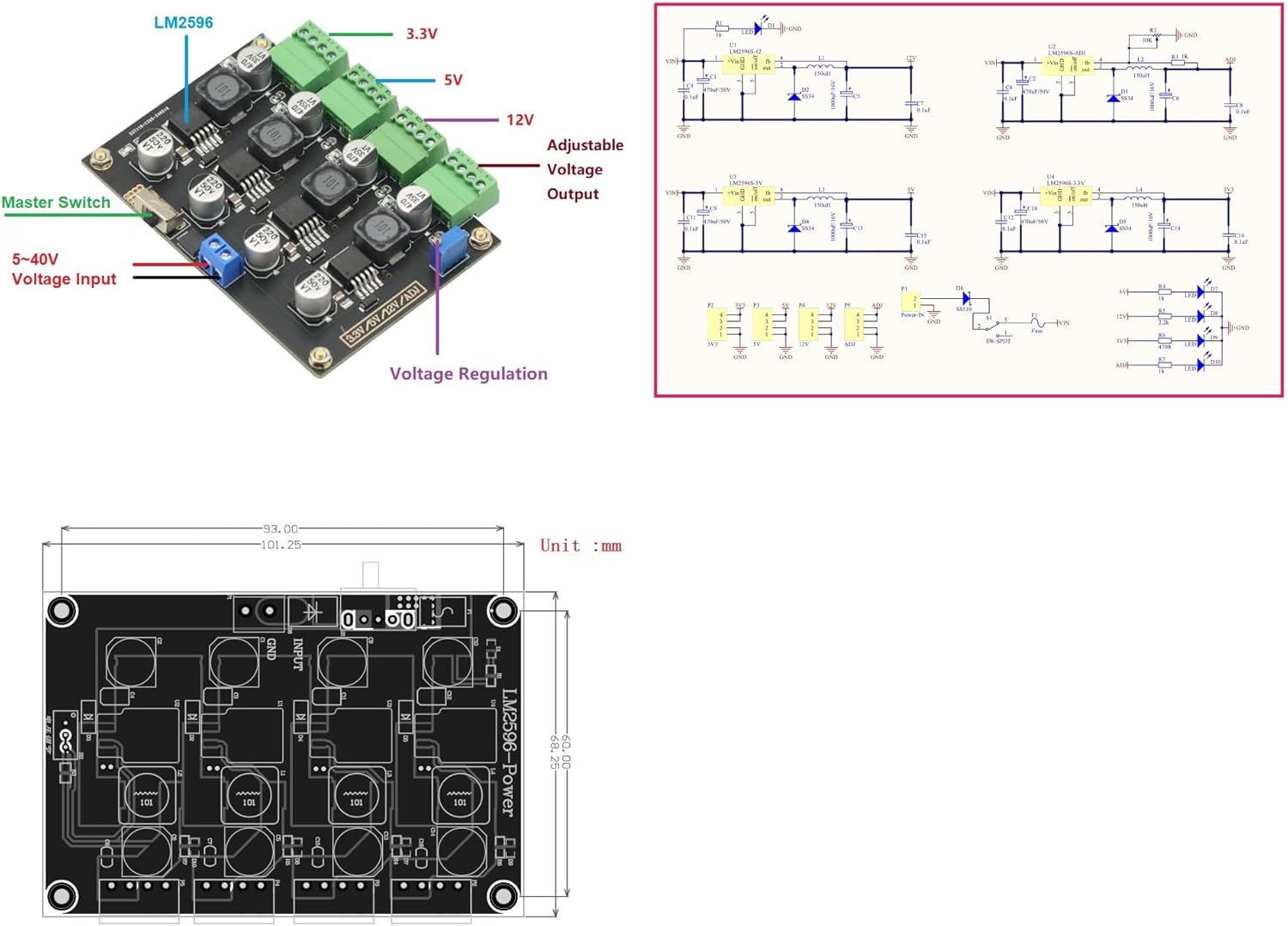
This is a well constructed four voltage power supply that is rated for input voltage up to 40 volts and outputs a nominal 3.3V, 5.0V, 12V, and a single variable voltage. The vendor made sure that the board was adequately protected by packing it in a mylar pouch wrapped in bubble wrap and then enclosed in a padded envelope. A set of standoffs was included.
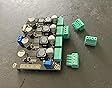
This is the perfect board if you need to supply 3.3V CMOS, 5.0V TTL, 12V to a power MOSFET circuit, and 6 to 8 volts to a micro controller, all in a single project. This prevents you from having to deploy several LM2596 modules. Just realize that the absolute max from each circuit on this board is 3A with a combined max of 5A, being based on the LM2596S chip. There are several design features that are most notable about this board. The first is the master on/off switch. The second is the removable output terminals.
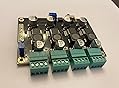
The nominal voltage at no load for the three fixed sources is 3.38V, 5.1V, 12.25V, which leaves some voltage headroom to account for voltage sag when under load conditions. Tested under the following loads: the 12V circuit supplied 2.0 amps at 12.2V, the 5V circuit delivered 1.4 amps at 5.04V, and the 3.3V circuit supplied 1.0 amps at 3.302V. Finally, I set the no load voltage of the variable circuit to 24.35V and had it supplying 2.1 amps at 24.05V. Note that I tend to keep the load on the LM2596S based circuits limited to about 2 amps without forced air circulation. I will note that during testing the board under the LM2596S chips heated up to a higher temperature than the chip itself, indicating that the manufacturer has designed heat dissipation into the board of this module. See the pictures for my wire wound resistor testing setup.
Overall a well designed and thought out module for projects requiring multiple voltages. I think you could even use this for a 10S 36V LiPo application (42V when fully charged) as the absolute max voltage for the LM2596S is actually 45V per the datasheet. I'd love to see the manufacturer implement this same design concept with the 48V max LM2596HVS chip.







Report