ORICO M.2 NVMe SSD Enclosure, USB 3.1 Gen 2 (10 Gbps) PCIe External Adapter NVMe Case for 2230/2242/2260/2280 M.2 SSD up to 8TB, UASP Supported – M2PV

ORICO M.2 NVMe SSD Enclosure, USB 3.1 Gen 2 (10 Gbps) PCIe External Adapter NVMe Case for 2230/2242/2260/2280 M.2 SSD up to 8TB, UASP Supported – M2PV
Price: $18.99 - $14.19
(as of Oct 02,2025 15:39:03 UTC – Details)

Buy Now


To calculate the overall star rating and percentage breakdown by star, we don’t use a simple average. Instead, our system considers things like how recent a review is and if the reviewer bought the item on Amazon. It also analyzed reviews to verify trustworthiness.Learn more how customers reviews work on Amazon


Customers say

Customers find the M.2 NVMe SSD enclosure performs well with fast NVMe drives and delivers USB 10Gbps speeds, making it an outstanding value for money. The installation process is straightforward, with customers successfully installing 1TB WD SSDs, and they appreciate its decent build quality. The heat level receives mixed feedback – while some say it's better than alternatives, others note it gets quite hot. Compatibility is also mixed, with some customers reporting their NVMe disks work great while others say their drives are not recognized. The screw size receives mixed reviews, with some customers appreciating the included screwdriver while others report missing mounting hardware.

462 customers mention "Functionality"346 positive116 negative

Customers find that the hard drive enclosure works well, particularly with fast NVMe SSDs, and one customer mentions that the TRIM feature functions properly.

"Pros: Works great. Exactly as it should. Cons: The heatsink is metal but the rest of the body is plastic…." Read more
"Works well, but you MUST use the included USB cables instead of other cables…." Read more
"Unreliable – Frequently disconnected from my mac (Updated)…" Read more
"…I got this product and it works great and transfers at very high speed. my older sata m.2 enclosure wouldn't register on all my computers…." Read more
279 customers mention "Quality"224 positive55 negative

Customers find the hard drive enclosure to be of good quality, describing it as an awesome little case.

"It works great. I love its design. Great product." Read more
"…Other than that, it worked exactly how it was listed! Good product and a good price." Read more
"Great enclosure. Good value. Short cables about right length without excess to get tangled. Simple, straightforward instillation. Good design…." Read more
"I love Orico products. Good stuff for good price, good quality. The metal cover is the heat sink, I love this as my portable NVME…." Read more
187 customers mention "Ease of installation"144 positive43 negative

Customers find the M.2 NVMe SSD enclosure easy to install, with multiple customers successfully installing new 1 TB WD SSDs, and one customer noting that the cloning process took only minutes.

"Easy to install" Read more
"Excellent case for my new 2 TB NVMe! Very clear instructions; easy to install. Great performance. Dissipates heat efficiently…." Read more
"Good quality and easy to set up." Read more
"…The circuit board is press-fit into the base; barely in there at all. It is not robustly built…." Read more
152 customers mention "Transfer speed"112 positive40 negative

Customers praise the hard drive enclosure's transfer speed, noting it delivers USB 10Gbps speeds and provides blazing fast loading through USB C.

"Fast and nicely built." Read more
"Small, fast, I bought wrong Gen 3 990 4tb ssd for ps5, was going to return it, found this case. And so glad I didn't return…." Read more
"…Also mine is not fast. 425 read and 412 writes. Win 11 home USB-C 3.2 ver1 and 3.2 ver1 Type-USB…" Read more
"…I split it in to a backup and extra storage.. it works great and is very fast.. the second one has some issues with the connection (USB-C)…." Read more
149 customers mention "Value for money"126 positive23 negative

Customers find the hard drive enclosure to be an excellent value, appreciating its sturdy construction for the price.

"This is an excellent product that is inexpensive, reliable and allows one to connect any M.2 B-key NVMe SSD to a Mac or PC via USB 3+…." Read more
"Great price fir a very functional tool. One day delivery and it works.." Read more
"…Good product and a good price." Read more
"Great enclosure. Good value. Short cables about right length without excess to get tangled. Simple, straightforward instillation. Good design…." Read more
197 customers mention "Heat level"119 positive78 negative

Customers have mixed experiences with the hard drive enclosure's cooling performance, with some reporting better heat management while others note that it gets quite hot and doesn't dissipate heat well.

"…Nice sturdy case with heat dissipation fins and a thermal pad." Read more
"…These drives get hot and I want big safety margins and robust design. Final notes: Aesthetically, I quite like this product…." Read more
"…For the price, and the fact that it has a heat sink and comes with a thermal pad, this is currently my go-to for this type of use case…." Read more
"Great external drive and keeps you're drive cool." Read more
122 customers mention "Compatibility"64 positive58 negative

Customers have mixed experiences with the hard drive enclosure's compatibility: while some report it works well with NVMe disks and Macs, others mention their PCs fail to recognize the drive.

"Worked well with newer M.2 drives" Read more
"Listing says sata but this does not support sata drives, only sata cables" Read more
"Working perfectly on nvme ssd." Read more
"UPDATE 10/26/22 Does not work with macOS Monterrey and/or Ventura. It keeps disconnecting. It was working fine with macOS Big Sur…." Read more
119 customers mention "Screw size"40 positive79 negative

Customers have mixed experiences with the screw size of the enclosure, with some appreciating that it comes with screws and a screwdriver, while others report issues with missing screws, particularly those needed to secure the M.2 drive.

"…to perform a Drive Clone for a Laptop, I noticed that there was no screwdriver, that one of the packages were opened, and the ties for both cables…" Read more
"This is a good enclosure at a good price. The drive attachment does not require a screw it uses a rubber stopper…." Read more
"Doesn't come with a screw and the instructions are not in English. Got it to work so A+ there. Only got one pad and no idea what it's used for…." Read more
"Finicky screws don't go into the holes. No way to hold down the nvme cartridge" Read more


Great budget option using an m.2 NVMe SSD as USB storage

5 out of 5 stars

Great budget option using an m.2 NVMe SSD as USB storage
I purchased this NVMe SSD enclosure because it had a decent price, in addition to using a design that provides a heatspreader for the SSD. While it supports NVMe SSDs with no problem, it is important to understand that this does not act as a HBA, instead when a drive is installed, it will show up as a “Realtek RTL9210 NVME SCSI Disk Device”. This means that you will not be able to update the firmware of the SSD in the enclosure or access any other low level functions. Instead all you will get is the SMART data, and the ability to initialize and format the drive in addition to normal reading and writing of user data. This means that if you need to update the firmware of your SSD, you will need to take it out of the enclosure and then connect it to the m.2 slot of a PC. (((Performance))) While the RTL9210 chipset supports NVMe and SATA, the enclosure is only wired for NVMe, thus you must use an NVMe SSD. The chipset also runs at PCIe 3.0 X2, but provides a USB interface of USB 3.1 Gen 2, for a speed of 10Gbps. In terms of real world performance, when using it with a Western Digital SN770 1TB drive, on a 10Gbps USB port (USB 3.2 gen 2), the enclosure reached a real world read speed of 1016.12 MB/s, and a real world write speed of 973.39MB/s. In repeating the tests on a 5Gbps USB port (USB 3.2 gen 1), the performance dropped significantly across the board, even in areas where the interface does not seem to be saturating, for example, performance drops in Q32T16 4K random reads and writes, even though the drive cannot offer 4K random at speeds fast enough to saturate either a 5Gbps or 10Gbps interface. Under a 5Gbps port, the read speeds dropped to 442.36MB/s and the writes dropped to 414.54MB/s. This overall indicates some additional overhead is taking place when the enclosure is operating in the 5Gbps mode. (((Installation and Setup))) The enclosure is quite easy to set up and install. Simply unscrew the single torx screw holding the cover that doubles as a heatsink/ heatspreader. Then lift the heatspreader up at the area you just unscrewed (The heatsink hinges out rather than slides). The bottom half of the case is made out of plastic, but has a metal threaded insert for the screw mount of the heatspreader. The top heatspreader is made out of aluminum. The thermal pad is a standard 1mm thermal pad, though the protective film is a bit thick, thus be sure to remove both pieces of protective film before closing the lid. The gap between the SSD and heatsink is about 0.99mm when closed. To install the SSD into the enclosure, first remove the PCB of the enclosure (there are no screws or clips holding it in place). Then insert the rubber retainer for the SSD in the hole that corresponds to the length of your SSD. A standard 2280 SSD would require the use of the 4th hole (hole farthest from the USB-C port on the PCB). It will take some effort to get the rubber peg through the hole as it relies on a friction fit to stay in place. Next, insert your SSD, and while pressing it down, also bent the rubber retainer out of the way enough for the SSD into position, then allow the rubber groove to grip onto the end of the SSD. Next, take the thermal pad, and notice the protective film on both sides of it. Peel off one side of the protective film and place the thermal pad onto the SSD (make sure to fully cover the controller and DRAM IC of the SSD (if available), covering the NAND package is not really needed as they do not get very warm, though it is not an issue if it is covered since the heat spreader does not have much thermal mass and does not dissipate a large amount of heat, this it will not overly cool the NAND package. After the thermal pad has been placed on the drive, peel off the remaining protective film slowly. Once that is done, install the heatspreader by first placing the lip of the heat spreader into the groove at the front of the case where the USB-C port is located, then bring the other end of the heatspreader own, closing the case like a clamshell. This will ensure no sliding motion that can cause the thermal pad to shift or rip. In my testing with a WD black SN770, the controller reaches a temperature of 71C under a sustained write intensive load, while the NAND reaches a temperature of 46C. The setup process is simple and straight forward. On the first power up of the enclosure with the SSD installed, let the enclosure run for a little while to give windows time to install any needed generic drivers. After that, head to your disk management utility, and then initialize the SSD (I recommend using the GPT partition table). After that, you can create a new NTFS volume for the SSD, and then begin using it as you would any other flash drive. (((Closing Thoughts))) If you need a lot of storage (especially in the 1TB+ range), an NVMe enclosure is a far better value and also allows for far better quality. Many standard flash drives that are 1TB+ often use very low binned NAND which will not consistently saturate a 10Gbps connection during extended writes, while many decent TLC NAND based NVME SSDs, will easily offer over 1GB/s even when the pSLC cache has run out, thus in the vast majority of cases, the enclosure will perform exactly the same from 0-100% fill. Update: So far the enclosure continues to work very, well with consistent performance, even for demanding workloads. The controller does not get very warm, and using it for recording higher bit rate footage with a camera for an extended period of time yielded great results. So far I have used a second one with a 2TB SSD, and I eventually plan to purchase a 4TB SSD to use with it.

Thank you for your feedback

Sorry, there was an error

Sorry we couldn't load the review


Top reviews from the United States


  • Reviewed in the United States on August 18, 2023

    Model: M.2 NVMEVerified Purchase

    I purchased this NVMe SSD enclosure because it had a decent price, in addition to using a design that provides a heatspreader for the SSD.

    While it supports NVMe SSDs with no problem, it is important to understand that this does not act as a HBA, instead when a drive is installed, it will show up as a “Realtek RTL9210 NVME SCSI Disk Device”. This means that you will not be able to update the firmware of the SSD in the enclosure or access any other low level functions. Instead all you will get is the SMART data, and the ability to initialize and format the drive in addition to normal reading and writing of user data. This means that if you need to update the firmware of your SSD, you will need to take it out of the enclosure and then connect it to the m.2 slot of a PC.

    (((Performance)))
    While the RTL9210 chipset supports NVMe and SATA, the enclosure is only wired for NVMe, thus you must use an NVMe SSD. The chipset also runs at PCIe 3.0 X2, but provides a USB interface of USB 3.1 Gen 2, for a speed of 10Gbps. In terms of real world performance, when using it with a Western Digital SN770 1TB drive, on a 10Gbps USB port (USB 3.2 gen 2), the enclosure reached a real world read speed of 1016.12 MB/s, and a real world write speed of 973.39MB/s.
    In repeating the tests on a 5Gbps USB port (USB 3.2 gen 1), the performance dropped significantly across the board, even in areas where the interface does not seem to be saturating, for example, performance drops in Q32T16 4K random reads and writes, even though the drive cannot offer 4K random at speeds fast enough to saturate either a 5Gbps or 10Gbps interface. Under a 5Gbps port, the read speeds dropped to 442.36MB/s and the writes dropped to 414.54MB/s.
    This overall indicates some additional overhead is taking place when the enclosure is operating in the 5Gbps mode.

    (((Installation and Setup)))
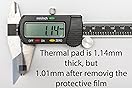
    The enclosure is quite easy to set up and install. Simply unscrew the single torx screw holding the cover that doubles as a heatsink/ heatspreader. Then lift the heatspreader up at the area you just unscrewed (The heatsink hinges out rather than slides). The bottom half of the case is made out of plastic, but has a metal threaded insert for the screw mount of the heatspreader. The top heatspreader is made out of aluminum. The thermal pad is a standard 1mm thermal pad, though the protective film is a bit thick, thus be sure to remove both pieces of protective film before closing the lid. The gap between the SSD and heatsink is about 0.99mm when closed.
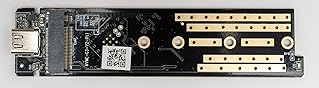
    To install the SSD into the enclosure, first remove the PCB of the enclosure (there are no screws or clips holding it in place). Then insert the rubber retainer for the SSD in the hole that corresponds to the length of your SSD. A standard 2280 SSD would require the use of the 4th hole (hole farthest from the USB-C port on the PCB). It will take some effort to get the rubber peg through the hole as it relies on a friction fit to stay in place. Next, insert your SSD, and while pressing it down, also bent the rubber retainer out of the way enough for the SSD into position, then allow the rubber groove to grip onto the end of the SSD.
    Next, take the thermal pad, and notice the protective film on both sides of it. Peel off one side of the protective film and place the thermal pad onto the SSD (make sure to fully cover the controller and DRAM IC of the SSD (if available), covering the NAND package is not really needed as they do not get very warm, though it is not an issue if it is covered since the heat spreader does not have much thermal mass and does not dissipate a large amount of heat, this it will not overly cool the NAND package. After the thermal pad has been placed on the drive, peel off the remaining protective film slowly. Once that is done, install the heatspreader by first placing the lip of the heat spreader into the groove at the front of the case where the USB-C port is located, then bring the other end of the heatspreader own, closing the case like a clamshell. This will ensure no sliding motion that can cause the thermal pad to shift or rip.
    In my testing with a WD black SN770, the controller reaches a temperature of 71C under a sustained write intensive load, while the NAND reaches a temperature of 46C.

    The setup process is simple and straight forward. On the first power up of the enclosure with the SSD installed, let the enclosure run for a little while to give windows time to install any needed generic drivers. After that, head to your disk management utility, and then initialize the SSD (I recommend using the GPT partition table). After that, you can create a new NTFS volume for the SSD, and then begin using it as you would any other flash drive.

    (((Closing Thoughts)))

    If you need a lot of storage (especially in the 1TB+ range), an NVMe enclosure is a far better value and also allows for far better quality. Many standard flash drives that are 1TB+ often use very low binned NAND which will not consistently saturate a 10Gbps connection during extended writes, while many decent TLC NAND based NVME SSDs, will easily offer over 1GB/s even when the pSLC cache has run out, thus in the vast majority of cases, the enclosure will perform exactly the same from 0-100% fill.

    Update: So far the enclosure continues to work very, well with consistent performance, even for demanding workloads. The controller does not get very warm, and using it for recording higher bit rate footage with a camera for an extended period of time yielded great results. So far I have used a second one with a 2TB SSD, and I eventually plan to purchase a 4TB SSD to use with it.

    Customer image


    5.0 out of 5 stars

    Great budget option using an m.2 NVMe SSD as USB storage

    Reviewed in the United States on August 18, 2023


    I purchased this NVMe SSD enclosure because it had a decent price, in addition to using a design that provides a heatspreader for the SSD.

    While it supports NVMe SSDs with no problem, it is important to understand that this does not act as a HBA, instead when a drive is installed, it will show up as a “Realtek RTL9210 NVME SCSI Disk Device”. This means that you will not be able to update the firmware of the SSD in the enclosure or access any other low level functions. Instead all you will get is the SMART data, and the ability to initialize and format the drive in addition to normal reading and writing of user data. This means that if you need to update the firmware of your SSD, you will need to take it out of the enclosure and then connect it to the m.2 slot of a PC.

    (((Performance)))
    While the RTL9210 chipset supports NVMe and SATA, the enclosure is only wired for NVMe, thus you must use an NVMe SSD. The chipset also runs at PCIe 3.0 X2, but provides a USB interface of USB 3.1 Gen 2, for a speed of 10Gbps. In terms of real world performance, when using it with a Western Digital SN770 1TB drive, on a 10Gbps USB port (USB 3.2 gen 2), the enclosure reached a real world read speed of 1016.12 MB/s, and a real world write speed of 973.39MB/s.
    In repeating the tests on a 5Gbps USB port (USB 3.2 gen 1), the performance dropped significantly across the board, even in areas where the interface does not seem to be saturating, for example, performance drops in Q32T16 4K random reads and writes, even though the drive cannot offer 4K random at speeds fast enough to saturate either a 5Gbps or 10Gbps interface. Under a 5Gbps port, the read speeds dropped to 442.36MB/s and the writes dropped to 414.54MB/s.
    This overall indicates some additional overhead is taking place when the enclosure is operating in the 5Gbps mode.

    (((Installation and Setup)))
    The enclosure is quite easy to set up and install. Simply unscrew the single torx screw holding the cover that doubles as a heatsink/ heatspreader. Then lift the heatspreader up at the area you just unscrewed (The heatsink hinges out rather than slides). The bottom half of the case is made out of plastic, but has a metal threaded insert for the screw mount of the heatspreader. The top heatspreader is made out of aluminum. The thermal pad is a standard 1mm thermal pad, though the protective film is a bit thick, thus be sure to remove both pieces of protective film before closing the lid. The gap between the SSD and heatsink is about 0.99mm when closed.
    To install the SSD into the enclosure, first remove the PCB of the enclosure (there are no screws or clips holding it in place). Then insert the rubber retainer for the SSD in the hole that corresponds to the length of your SSD. A standard 2280 SSD would require the use of the 4th hole (hole farthest from the USB-C port on the PCB). It will take some effort to get the rubber peg through the hole as it relies on a friction fit to stay in place. Next, insert your SSD, and while pressing it down, also bent the rubber retainer out of the way enough for the SSD into position, then allow the rubber groove to grip onto the end of the SSD.
    Next, take the thermal pad, and notice the protective film on both sides of it. Peel off one side of the protective film and place the thermal pad onto the SSD (make sure to fully cover the controller and DRAM IC of the SSD (if available), covering the NAND package is not really needed as they do not get very warm, though it is not an issue if it is covered since the heat spreader does not have much thermal mass and does not dissipate a large amount of heat, this it will not overly cool the NAND package. After the thermal pad has been placed on the drive, peel off the remaining protective film slowly. Once that is done, install the heatspreader by first placing the lip of the heat spreader into the groove at the front of the case where the USB-C port is located, then bring the other end of the heatspreader own, closing the case like a clamshell. This will ensure no sliding motion that can cause the thermal pad to shift or rip.
    In my testing with a WD black SN770, the controller reaches a temperature of 71C under a sustained write intensive load, while the NAND reaches a temperature of 46C.

    The setup process is simple and straight forward. On the first power up of the enclosure with the SSD installed, let the enclosure run for a little while to give windows time to install any needed generic drivers. After that, head to your disk management utility, and then initialize the SSD (I recommend using the GPT partition table). After that, you can create a new NTFS volume for the SSD, and then begin using it as you would any other flash drive.

    (((Closing Thoughts)))

    If you need a lot of storage (especially in the 1TB+ range), an NVMe enclosure is a far better value and also allows for far better quality. Many standard flash drives that are 1TB+ often use very low binned NAND which will not consistently saturate a 10Gbps connection during extended writes, while many decent TLC NAND based NVME SSDs, will easily offer over 1GB/s even when the pSLC cache has run out, thus in the vast majority of cases, the enclosure will perform exactly the same from 0-100% fill.

    Update: So far the enclosure continues to work very, well with consistent performance, even for demanding workloads. The controller does not get very warm, and using it for recording higher bit rate footage with a camera for an extended period of time yielded great results. So far I have used a second one with a 2TB SSD, and I eventually plan to purchase a 4TB SSD to use with it.
    Images in this review

    Customer imageCustomer imageCustomer imageCustomer imageCustomer imageCustomer imageCustomer imageCustomer imageCustomer imageCustomer imageCustomer imageCustomer image

    186 people found this helpful


    Report


  • Reviewed in the United States on September 7, 2025

    Model: M.2 NVMEVerified Purchase

    Great for using replaced m.2 nvme memory modules. I got a new computer and wanted to use my old computer's m.2 modules as portable memory for my music and photo apps. I got this product and it works great and transfers at very high speed. my older sata m.2 enclosure wouldn't register on all my computers. This enclosure works on usbc or usba connectors on all my computers. very satisfied. doesn't get overly hot either. low price. Has thermal putty insert to ensure good heat transfer to heat sink.


  • Reviewed in the United States on November 10, 2023

    Model: M.2 NVMEVerified Purchase

    So I am giving this 4 stars and will explain why, and also give instructions to do this without seeing, since i am blind and I hope this even helps sighted people assemble this right. Isn't it great when you figure things on your own? took me a while but here i am. I confess I almost asked for sighted assistance out of desperation.
    so 4 stars: it works. Does not really heat up too much but still worth it to feel on it from time to time and carefully consider what software you use to copy and so on, I did not need the pieces of paper or whatever things.. I think they are thermal pads or something. it also does not come with instructions and online they are hard or impossible to find. Cables it comes with are helpful, but more the USB C to USB a type and its good to have them, but I ended up using other more reliable cables that have served me for years when I used the unit. I tried scanning the piece of paper that came with it but nothing. I also tried to assemble it for about half an hour last night, and just gave up, too tired to even figure out a simple thing.
    Then I tried another half an hour today, I felt progress in the first 10 minutes, then intuition and creativity did their thing and well so I will explain how to put this together.
    Inside the box you will find the enclosure, which is about the size, length and thickness of a energy bar, or a cereal bar, really not too big. It is plastic and aluminum. ON one side of the stick there is the usb C port and on the other side, on top of the aliminum cover is a small hole. You will also find a bag with a replacement screw and two rubber caps and also a bag with a very small screwdriver you can use to manipulate the only center screw of the enclosure.
    So, to install a drive into this go ahead and take that screw off and place it in a cup or some place that is easy to retrieve. Like with all screws, the tip of the driver should snugly fit into the screw and you unscrew to the right.
    When you take the lid off, which should hinge open to be able to slide off the plastic you will find a card similar to a drive also made of plastic. You will see and feel (using your fingernail at first if you'd like) some tiny holes, a bit bigger than a braille dot. These correspond to 2230, 2242, 2260, and 2280 drives. The further away they are from the usb C por the bigger or longer the drive is. Take the pcb out of the case, it should slide easily but if it does not then put your fingers on the sides and try to pry it out. Not much effort is needed as there is really nothing holding it in, you could also use something to act as a small lever to get it out. There are grooves on this pcb which feel like soldered on chips, and they should be facing down. You can retrieve your ssd now and also the rubber cap.
    A word on that infamous kinda cone shaped rubber cap: this one is used to secure the drive once you insert it. You should practice putting it on without the drive first. The direction it should go is the thinnest tip facing down. You do need to apply some pressure and align it some, but the small tip should protrude on the other side and that is enough. You can also turn it upside down on a table and push it firmly so that the tip protrudes some more. There is actually no need to insert it really all of the way in which I guess is what many people here are doing somehow and that is really an impressive feat, because that has been kind of impossible for me. Take it out for the next steps though as its much easier to put the drive, then put the retainer.
    To install the drive:
    If you look or feel at the short side edges of the rectangular drive, and also using your fingernail carefully, you will notice it as a tiny dent. This actually is the PCIE port or the connector that makes anything recognize the drive. On the opposite side there is a bigger dent at the very center which is the edge of the drive. If you feel past the USB port on the pcb, you will also notice that there is a small rectangular groove where this tiny dent part of the sd should be fitted on. Assuming you have placed the USB c on to your left, the port where this tiny dent goes should be facing away from you, you can actually feel it if you run your fingernail across the groove. Grab the ssd with two or three fingers, only touching the long front and back edges, almost as if your hand is a clamp. With the other hand, hold the pcb in a straight line, and line up the edge of the drive with the port or groove of the pcb, and the drive should be diagonally pointed (downwards) towards the port. Then, carefully but firmly push to slide the drive into the port of the pcb. If done correctly, the drive will cling to the pcb and if you stop touching it or release it, it should stick upwards a bit. you can carefully and slowly push it down until it touches the pcb. It should go back up if you release it. To stop this from happening and to secure the drive, is time to use the rubber cap you practiced putting on earlier. You will notice that the bigger horseshoe shaped dent on the other side of the drive (or the edge of the drive) lines with the almost brailled sized hole of the pcb for the drive length, so the rubber should fit right in without applying too much pressure or too much effort. And once you have this assembled, then put the pcb bach in, similarly to how you put the drive on the pcb, aligning it with the USB C port facing diagonally and down towards the USB opening on the plastic base. Then put the aluminum cover back in, put the screw back in, and you are done.
    I really hope this helps someone.

    24 people found this helpful


    Report


  • Reviewed in the United States on September 22, 2025

    Model: M.2 NVMEVerified Purchase

    Works as it should. Gets a little hot…wich is goos because taht means the the SSD is not getting too hot. Cable lenght is adecuate for a PC next to you. Short cable.


Top reviews from other countries

Translate all reviews to English


  • lithun
    5.0 out of 5 stars

    good and easy installation

    Reviewed in the United Arab Emirates on June 25, 2024

    Model: M.2 NVMEVerified Purchase

    good design
    come with type c and usb cables and screw driver and heat sink pad


  • Bostitch
    5.0 out of 5 stars

    Great item.

    Reviewed in Canada on September 3, 2025

    Model: M2PV-USVerified Purchase

    I have been using for awhile now and works great. Good deal.


  • Hector
    5.0 out of 5 stars

    Muy buena carcaza

    Reviewed in Mexico on June 9, 2025

    Model: M.2 NVMEVerified Purchase

    Excelente producto de marca reconocida


    Report


  • Queen British
    5.0 out of 5 stars

    Queen British

    Reviewed in Saudi Arabia on September 21, 2024

    Model: M.2 NVMEVerified Purchase

    سهل وخفيف


  • 山田正文
    5.0 out of 5 stars

    GEN4 m.2SSDはけっこう発熱するので、熱がこもったりするのはよくありません。

    Reviewed in Japan on August 24, 2025

    コスパがgoodです。
    蓋がヒートシンクな所が気に入りました。


Product Summary: ORICO M.2 NVMe SSD Enclosure, USB 3.1 Gen 2 (10 Gbps) PCIe External Adapter NVMe Case for 2230/2242/2260/2280 M.2 SSD up to 8TB, UASP Supported – M2PV

From ORICO
10 Gbps HIGH SPEED: ORICO M.2 NVMe SSD external case adopts Realtek RTL 9210 control chip and latest USB 3.1 Gen 2 Type-C interface. Support UASP acceleration protocol and support theoretical data transmission speed of up to 10Gbps. When using high-performance NVMe media, the read/write performance can exceed 900 Mbytes/sec. Included USB-C to USB-C and USB-C to USB-A cables, works with USB-C/USB-A hosts.
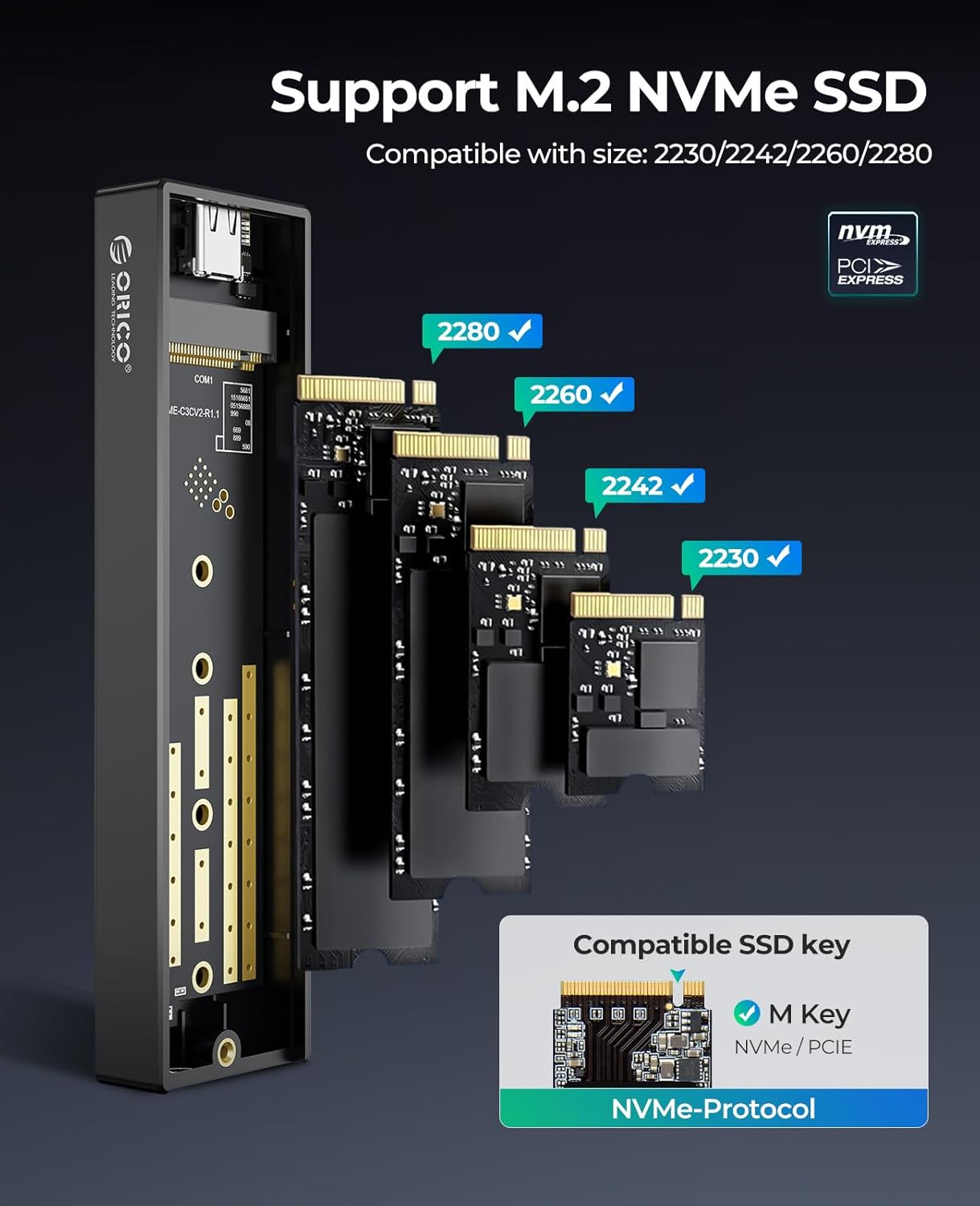
ONLY SUITABLE FOR PCIe NVMe M.2 SSD: ORICO M.2 to USB enclosure only for NVMe M-Key M.2 SSD (PCIe-based) up to 8 TB, applicable to sizes 2230 / 2242 / 2260 / 2280 SSDs, ORICO PCIe NVMe case does not support M.2 SATA based SSDs, M.2 PCIe AHCI SSDs, and any SSD from Mac.
SUPPORT MULTIPLE OPERATING SYSTEMS: ORICO M.2 enclosure is engineered with USB 3.1 Type c interface, support hot-shippable, Plug and Play, No Driver required. Supports Window / Mac / Linux. This external hard disk box is suitable for connecting computers, Smartphones, laptops, PS4, and other devices. Please note, all new solid-state drives must be formatted before use.
DESIGNED FOR CARRYING AROUND: This ORICO external case is made of aluminum top and plastic bottom, which ensures portability and good heat dissipation effect. 108 mm * 29.5 mm * 13.5 mm portable size is very convenient for carrying. You can put your M.2 NVMe hard drive in this enclosure and equip it with Windows or macOS systems, as an external drive.
UPGRADED CABLE DESIGN: To provide ultimate convenience, this NVMe enclosure now may come with an ALL-NEW 2-in1 data cable (USB-C to C + USB-C to A) instead of two separate cables. You will receive one of them randomly, both support high-speed data transfer and charging

Buy Now